Dental Payment Stacking: The Complete Guide for Treatment Coordinators
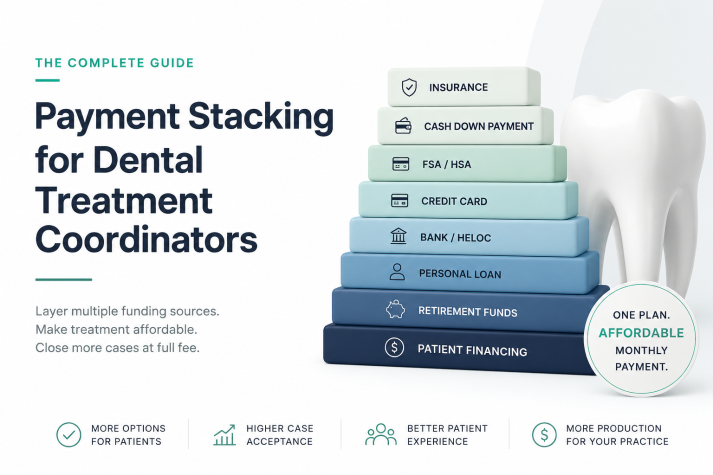
Payment stacking is the structured process of identifying and layering multiple patient funding sources to make large dental treatment plans affordable, without discounting fees. This post defines each funding method, explains how treatment coordinators can present them conversationally, and shows how combining resources in sequence closes cases that single-source presentations consistently lose.
Most dental practices present $15,000+ treatment plans the same way as presenting a $1,000 procedure. Insurance first. One financing option second. If neither covers the total, the conversation stalls and the patient goes home to think about it.
That approach fails at scale because it treats the funding conversation as a single transaction rather than a layered strategy. A patient sitting in a large case consultation is rarely holding just one financial resource. Most are holding several. Payment stacking is the methodology that helps patient uncover their available resources so that they can afford the dental treatment they need and desire.
What Payment Stacking Does to a Large Case
What does payment stacking actually look like?
In reality financing alone is not always enough to cover large dollar treatment plans. Consider the following $40,000 payment stacking example:
| Funding Source | Amount Applied |
| Dental Insurance | $1,500 |
| Cash Down Payment | $5,000 |
| FSA Balance | $3,400 |
| Credit Card 0% Interest (18 months) | $4,000 |
| Patient Financing | $26,100 |
| Total Treatment Funded | $40,000 |
| Est. Monthly Payment (84 months) | $365 to $400 |
Without the use of payment stacking, in theory this patient would have been forced to finance nearly $40,000 (less dental $1,500 dental insurance). In reality, this patient was only approved for $28,000 in patient financing.
Because the patient used dental insurance, made a cash down payment, maximized FSA benefits and even leveraged an interest-free credit card promotion, only $26,100 was required in financing, well within the amount she was approved for.
Payment stacking doesn’t change the fee. It changes how the procedure becomes affordable.
Shifting your patient’s focus to an estimated monthly payment of $365 to $400 significantly increases the treatment coordinator’s ability to close the deal.
What Every Treatment Coordinator Should Know Before the Consultation
Why do some patients appear to pay cash for large treatment cases?
When your patient pays for a $25,000+ treatment plan in cash, it doesn’t always mean the funds were liquid, sitting in a checking account. Patients routinely fund large purchases through a HELOC withdrawal, a personal loan from their credit union, or even a loan or withdrawal from a retirement fund. Those funds land in their account before the appointment and arrives at your office in the form of a check.
The treatment coordinator who understands this dynamic has a complete picture of what the patient may actually have available, and a more informed set of questions to ask during the funding discovery conversation.
The Nine Funding Methods and How to Present Each One
What funding sources are used in a consultation for payment stacking?
Dental Insurance. Most annual plans max out between $1,500 and $2,000. In a comprehensive treatment plan this only covers a modest portion but it’s the easiest to secure so it’s usually entered first. Insurance establishes the framework, signals to the patient that their existing benefits are useful, and sets the tone that your practice has thought through every available resource.
Cash Down Payment. Here’s where you’ll ask an open-ended question regarding how much of the patient’s fee will be handled with cash. “Ms. Smith how much of a cash down payment are you prepared to apply to your treatment?” Whatever the patient suggest reduces the financing gap and represents a commitment to treatment.
Flexible Spending Account (FSA). A Flexible Spending Account is a special account your patient put money into that they use to pay for out-of-pocket health care costs. Most people are at least aware of an FSA option. In 2026 a $3,400 FSA election translates directly to an affordable $130 bi-weekly tax-free payment plan toward needed treatment. One great advantage of an FSA is that the full elected balance for the year is usually available for use at the beginning of the plan year, before a single paycheck contribution has been made.¹ An FSA is an amazingly patient resource that is overlooked by low producing practices. Payment stacking encourages FSA usage.
Health Savings Account (HSA). An HSA is a tax-advantaged account that can be used to pay for qualified medical/dental expenses. A huge benefit of an HSA is that their balances accumulate over time and many patients haven’t touched their HSAs in years. According to Truemed, the average balance in HSA accounts containing both cash and invested assets is $22,635.² Across all 40 million HSA accounts nationwide, total assets reached $159 billion as of mid-2025.³ HSAs are one of the most significant and underutilized patient funding sources in dentistry. Payment stacking encourages conversations about potential use of an HSA.
Patient Financing. Financing is the gap-closer in a payment stack, not necessarily the first funding source. In payment stacking, patient financing’s job is to cover whatever balance remains after other sources have been applied. This leaves a monthly payment the patient can best afford. The term length and interest rate is the lever that controls the monthly number. Case Closed Pro allows the treatment coordinator to run estimated monthly finance payments on the spot by selecting an interest rate and repayment terms. Patient financing is a powerful payment stacking tool.
Credit Card. Most patients carry at least one card with available credit, often offering 0% promotional interest rates. Interest-free promotional periods, usually between six to 21 months, can make a credit card one of the most cost-effective short-term options on a remaining gap. Rewards-focused patients may specifically want to use a card that earns points or cash back on a large purchase. Which ever option serves your patient’s needs greatest is usually the best option.
Personal Loan. A patient who prefers to work through their own bank or credit union may already have a personal loan in place before they arrive at your office. What appears to be a cash payment is sometimes a personal loan the patient secured independently. Asking whether the patient has explored financing options through their existing banking relationship opens a new door. Most treatment coordinators never explore this option with their patient, but personal loan rates through established institutions are often competitive. Since patients taking out a personal loan will pay for treatment in cash, a typical 5% cash discount can encourage a patient to explore this option.
Home Equity Line of Credit (HELOC). Homeowners with available equity have access to one of the lowest borrowing rates available for large purchases. Many patients who pay what looks like a lump sum for a full arch implant case actually drew that money from a HELOC before the appointment. Asking whether the patient owns their home and has considered using available equity surfaces a legitimate path that most practices never raise. The treatment coordinator’s role is to surface the question, not to advise on the financial decision itself. Often the patient decides that a HELOC is the best, most affordable option for satisfying needed healthcare.
Retirement Plan Loan. Most 401(k), 403(b), and 457(b) plans allow loans of up to 50% of the vested balance or $50,000, whichever is less. This is a standard IRS provision available to most employees with an active retirement plan.⁴ The loan is repaid through payroll deductions at low interest rates. The interest paid is deposited back into your patient’s retirement fund. A patient who appears to be paying cash for a $30,000 procedure may have borrowed from their retirement plan. This happens routinely. Why not ask the patient if they’ve considered this option? It could be the difference in helping a patient get the treatment they need or not.
Dental Payment Stacking Is a Difference-maker
According to the West Health-Gallup Healthcare Affordability Index, Americans’ ability to cover healthcare costs has declined in recent years, with millions facing higher premiums and rising out-of-pocket expenses in 2026.⁵ Even still, comprehensive dental care can be genuinely affordable. It’s about helping patients make informed decision by sharing common resources used to pay for treatment.
Payment stacking makes it all possible by turning an overwhelming total into a layered, monthly number that’s built from resources the patient already has. When treatment becomes financially visible it becomes possible in the patient’s mind. That’s when patients say yes to the dental care that genuinely changes their quality of life.
For the practice, the return on building this capability is immediate and compounding. Every large case that closes for the full fee is a case that didn’t require a discount, a staged treatment plan, or a follow-up that never happens.
Payment stacking isn’t a financing workaround. It’s a production strategy. When your practice fully adopts this approach, you’ll close more comprehensive rehab cases. You’ll build a patient base that arrives better prepared, commits more confidently, and refers others who do the same.
FAQ
Common questions about dental payment stacking
Dental payment stacking is the structured process of identifying and combining multiple patient funding sources, such as insurance, FSA, HSA, cash, financing and other financial resources and assets. The key is to make large dental treatment plans affordable without discounting the fee or being controlled by PPOs. A treatment coordinator who trained in dental payment stacking, is prepared to consider every applicable funding method. Case Closed Pro is the calculator built precisely to execute this process during a live treatment consultation.
Most large cases are closed using three to five funding sources are presented depending on what the patient has available. The goal is not to present every possible method but to identify the combination that reduces the financing gap enough to produce a monthly payment the patient can say yes to. Presenting too many options at once can overwhelm a patient, therefore Case Closed Pro trains treatment coordinators to sequence their discussion of resources from most familiar to least.
Patients who present with large cash payments, frequently draw funds through a home equity line of credit (HELOC), personal loan, or borrowing from a retirement plan. They just didn’t tell you where the cash came from. But understanding this dynamic helps treatment coordinators ask better funding discovery questions and recognize that patients may have access to resources that they haven’t volunteered or considered. The funding conversation should never assume a patient’s only options are insurance and third-party financing.
The dental payment stacking conversation should begin before the treatment total is presented, not after. A treatment coordinator who conducts a brief funding discovery conversation early in the consultation builds the stack before the patient hears the number. When the total is presented alongside a personalized payment plan showing every source applied, the patient experiences the affordability solution and the treatment cost at the same moment.
Case Closed Pro is more than a dental treatment financing calculator. It allows the treatment coordinator to walk a patient through as many as 11 funding methods, in a single session, building a personalized payment plan in real time. The calculator allows the treatment coordinator to adjust financing terms on the spot, share interest-free credit card promotional, encourage FSAs, HSAs, and various assets to make major dental procedures affordable. The software then generates a professional payment plan document the patient takes home. It turns the dental payment stacking methodology into an executable, repeatable consultation workflow.
No. Subscribers to Case Closed Pro are given access to training modules that teach treatment coordinator how to discuss and encourage several resources used in payment stacking. While user’s of Case Closed Pro are encouraged to review each of the training videos, it only takes about an hour total to review the videos.
References
- Internal Revenue Service. Revenue Procedure 2025-32: 2026 FSA Contribution Limits. October 2025. irs.gov
- Truemed. HSA Statistics, Facts, and Research for 2026. March 31, 2026. truemed.com/blog/hsa-statistics
- Devenir. 2025 Midyear HSA Research Report. 2025. devenir.com
- Internal Revenue Service. Retirement Plans FAQs Regarding Loans. irs.gov/retirement-plans/retirement-plans-faqs-regarding-loans
- West Health-Gallup. Healthcare Affordability Index. March 2026. gallup.com
Can I afford this?
More often than you think, the answer is yes.
Your team just needs the system to prove it.
Case-Closed Pro is a dental treatment financing calculator built for treatment coordinators who present large comprehensive cases. It combines up to twelve payment methods into a single patient-facing payment plan — built live, in the consult room, in minutes.