How Thomas’s $24,000 All-on-X Case Was Closed
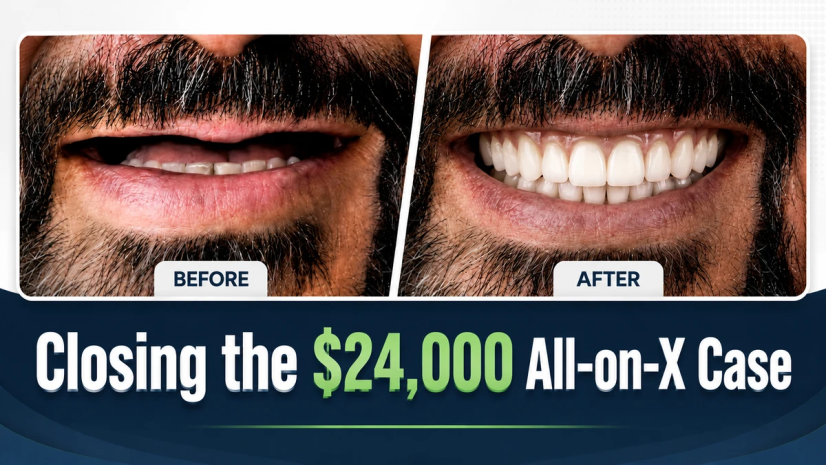
A 59-year old truck driver walked into an implant consultation carrying 15-years of frustration with a loose, ill-fitting upper denture. He figured the cost of the treatment would be about $10,000. The actual fee was $24,000. This post demonstrates how to close an All-on-X case in spite of a patient’s common experience with sticker shock.
Most patients who need a full arch implant procedure have been living with a compromised solution for years. A loose denture. A partial that no longer functions. A mouth they’ve quietly learned to manage around.
By the time they sit across from a treatment coordinator, the surgeon has already made the clinical case. The only thing standing between that patient and life-changing treatment is the financial conversation. How the treatment coordinator handles that conversation determines everything.
Thomas’s story is a clear picture of what happens when that conversation is handled well.
Meet Thomas: Loose Denture, Bone Loss and the $24,000 Solution
Who is Thomas and what dental treatment did he need?
Thomas is fifty-nine years old and has spent more than thirty years behind the wheel for a nationally recognized trucking company. He is dependable, straightforward, and not someone who spends money on himself without good reason.
For over fifteen years, Thomas had been managing a loose, ill-fitting upper denture that functioned poorly when chewing. He had learned to work around it. His wife had been encouraging him to do something about it for years.
Given the extent of his bone loss, the surgeon recommended full arch All-on-X implants to replace his denture. The total treatment fee was $24,000.
The Moment the Patient Understands the All-on-X Fee is More Than Anticipated
What should a treatment coordinator do when a patient reacts to a large treatment fee?
Before revealing any dollar amount, the treatment coordinator asked Thomas a question most practices skip entirely. She asked: “Thomas, before I share the cost of your proposed treatment plan, I’m curious what you think a full arch implant procedure like this typically runs?”
Thomas’s best guess was for $10,000.
She then told him “the actual fee is $24,000 for this implant procedure.” And then she went silent. She didn’t immediately explain, justify, or soften the number.
In his bestselling book Gap Selling, author Jim Keenan writes that after presenting a cost, you should “shut your mouth and let the silence sit” and resist the urge to “justify, explain, or soften the price after you’ve shared it.”¹
Speaking first after naming a price signals a lack of confidence and invites pushback.
Thomas responded: “Wow. That’s a lot more than I had anticipated.”
That response is where most practices panic. They reach for a discount, or they quietly assume the patient can’t afford it. A seasoned treatment coordinator reads it differently.
She recognized it as the gap between sticker shock and possibility. Her response will demonstrate that she understands how to close an All-on-X case.
How the Treatment Coordinator’s Response Led to Closing the Case
How should a treatment coordinator respond when a patient reacts to a large implant fee?
The treatment coordinator responded with confidence:
“Thomas, I know this is no small number. But we’ve helped several patients figure out a way to make this procedure fit within their budget.
With your permission I’d like to share a few common strategies that our patients use to make this procedure affordable. Would that be okay?”
If it seems this response is scripted, you’re right! It’s highly scripted. She says it every time. An experienced implant treatment coordinator anticipates a reaction similar to Thomas’s. In doing so they can be prepared to respond in a way that actually calms the patient and continues the conversation forward, anxiety-free.
This is a pivotal phase in the full arch consultation and it deserves a consistent and effective response.
The All-on-X Smile Simulation That Changed Everything
How does an AI-generated smile simulation affect patient case acceptance?
With Thomas’s permission, the treatment coordinator opened Case Closed Pro. The first thing she did was upload a photo of Thomas’s mouth without his denture.
Within seconds, the software generated an after image of what his smile could look like following the All-on-X procedure. Thomas became visibly intrigued. She could tell he wanted it.
In my experience, this is the most important moment in the consultation. When the patient’s desire for the outcome reaches its highest point, their desire to find a financial solution reaches its peak as well.
That is exactly when the door opens to having a productive payment strategy conversation.
Building the Payment Stack in Real Time Starting with Dental Insurance
How did the treatment coordinator make a $24,000 implant case affordable for Thomas?
With the after image on screen and Thomas now emotionally engaged, the treatment coordinator began working through the available funding sources. She started with dental insurance, which most implant coordinators dismiss too quickly.
Whether a practice is in-network or fee-for-service, patients still perceive their dental benefits as valuable. When the treatment coordinator demonstrates a genuine interest in maximizing those benefits, the patient reads that as empathy and thoroughness. This helps move the case forward.
Thomas had $1,500 available through his dental insurance. Those benefits were fully applied through x-rays, a CT scan, a complete examination, bone grafting, and the immediate provisional prosthesis.
Thomas didn’t require extraction, but extractions are commonly used to help patients reach their annual maximum in these cases as well.
Each of those charges fell within the total cost of his All-on-X procedure. This dropped his net remaining balance to $22,500.
Payment Stacking Completed with Cash and Patient Financing
How did cash and patient financing close the remaining gap on Thomas’s implant case?
Next, she asked Thomas if he was in a position to make a cash down payment. He was able to commit to $3,000 cash. That brought the remaining amount needed to $19,500.
Before suggesting third-party patient financing, the implant treatment coordinator asked Thomas if he had already set healthcare funds aside through either an FSA or HSA.
It is entirely possible that an FSA could partially fund a patient’s implant procedure, or that an HSA could fully fund a patient’s implant procedure and they not realize it. In Thomas’s case there was no FSA and no HSA available.
The path to closing the case ran through patient financing. She asked Thomas where his monthly payment needed to be for this to work within his budget. He said somewhere around three hundred dollars would be ideal.
Once Thomas suggested that his credit was solid, she used the Case Closed Pro dental calculator to run the $19,500, at 7% over six years.
The estimated monthly payment came back at nearly $333. Thomas expressed that the monthly payment estimate was higher than he was comfortable with. So the treatment coordinator extended the term from six to seven years. She held the rate at 7%.
This dropped the estimated monthly payment to approximately $294 a month. Thomas could see both scenarios on screen in real time. His expression confirmed he was comfortable with the revised terms.
Thomas’s Complete All-on-X Payment Stack
What does a complete dental payment stack look like on a $24,000 All-on-X case?
Now that the treatment coordinator was able to find Thomas’s monthly payment comfort level, she immediately solidified his agreement on the terms, in principle. The only thing to do next was to encourage Thomas to complete a quick patient financing application.
She told him it would take less than five minutes to know what he was approved for and that there would be no inquiry placed on his credit report until, and unless he accepted the loan.
She walked him through a quick financing application with Proceed Finance. He was approved for far more than the $19,500 he needed to complete his payment gap.
He understood that Proceed Finance would not place an inquiry on his credit report unless he accepted the loan.
Thomas’s stack, assembled in a single session, looked like this:
| Funding Source | Amount |
| Dental Insurance | $1,500 |
| Cash Down Payment | $3,000 |
| Patient Financing (7% / 84 mos.) | $19,500 |
| Total Treatment Funded | $24,000 |
| Est. Monthly Payment | $294 |
Dental payment stacking: the structured process of identifying and layering multiple patient funding sources such as insurance, cash, FSA, HSA, third-party patient financing, personal loans, and personal assets to make high-cost treatment plans affordable without discounting fees.
How Thomas Left His Full-Arch Implant Consultation
What does a patient take home after a payment planning session for an All-on-X procedure?
At the end of the session, Case Closed Pro generated a personalized payment plan printout for Thomas. It included the smile simulation showing Before and After images, an itemized breakdown of his chosen funding sources, and the monthly payment figure he had agreed was workable.
Thomas had a financial path to treatment he could take home and share with his wife — the same person who had been encouraging him to address his situation for years. That document did not require much explanation. The numbers were clear. The after image made the case visually.
A couple of days later, the treatment coordinator followed up with a phone call. After answering a few questions Thomas had sitting with the plan overnight, he agreed to move forward. The practice scheduled him for his full arch fixed implant surgery.
A classic example of how to close an All-on-X case. Another case closed. Another patient helped.
How the Case Closed Pro Calculator Makes Closing Large Cases Predictable
How does Case Closed Pro support the payment stacking process in a live consultation?
The Thomas case demonstrates what a well-run payment planning session produces. No fee discount was offered. No assumption was made that the patient couldn’t afford the proposed full arch implant treatment, in spite of his obvious sticker shock.
What changed was the patient’s experience of making a large fee feel affordable. Case Closed Pro is the dental calculator built specifically for large dental fee presentations like Thomas’s.
The treatment coordinator entered each funding source, ran two financing scenarios on the spot, adjusted the term in real time, and generated a professional payment plan printout before Thomas left the chair.
Every commonly used funding source. Every payment scenario. A professional plan in the patient’s hands before they walk out the door.
FAQs
Speak the fee clearly and then go silent. Attempting to justify or soften the number immediately after presenting it signals a lack of confidence and invites the patient to push back. Allow the patient to respond first, then use that response to open a structured payment strategy conversation. A calm, prepared treatment coordinator who listens before speaking closes more large cases than one who fills silence with explanations and discounts.
A patient expressing sticker shock is not the same as a patient who cannot afford treatment. The best treatment coordinators recognize the gap between the initial reaction and the patient’s potential financial capacity. Opening a payment stack that layers insurance, cash, and financing into a single monthly number often reveals that the patient can afford more than their first reaction suggested. The Case Closed Pro calculator makes this discovery possible in real time, with the patient watching.
Yes, when done correctly. In Thomas’s case, the difference between a six-year and seven-year financing term was the difference between a $333 monthly payment and a $294 payment. That $39 monthly difference was what moved Thomas from hesitant to committed. The treatment coordinator’s ability to run both scenarios on screen in seconds, without approximating or sending the patient home to calculate it themselves, is what made the adjustment credible and immediate.
A smile simulation shifts the patient’s emotional state from apprehension to desire. The simulation does not close the case on its own. But it creates the emotional context that makes the payment strategy conversation significantly more productive.
The treatment coordinator enters the total treatment fee and works through each available funding source with the patient in real time. As each source is applied, the remaining balance updates on screen. Financing terms can be adjusted instantly to show different monthly payment scenarios. At the end of the session, the calculator generates a professional, patient-facing payment plan document that includes the funding breakdown and the monthly payment. When an esthetic outcome is being proposed, a smile simulation image can be generated. The patient leaves with a complete financial picture rather than a vague number to think about.
References
- Keenan, Jim. Gap Selling: Getting the Customer to Yes. A Sales Guy Publishing, 2019.
Can I afford this?
More often than you think, the answer is yes.
Your team just needs the system to prove it.
Case-Closed Pro is a dental treatment financing calculator built for treatment coordinators who present large comprehensive cases. It combines up to twelve payment methods into a single patient-facing payment plan — built live, in the consult room, in minutes.