The Story of Robert and Use of Home Equity for Dental Care
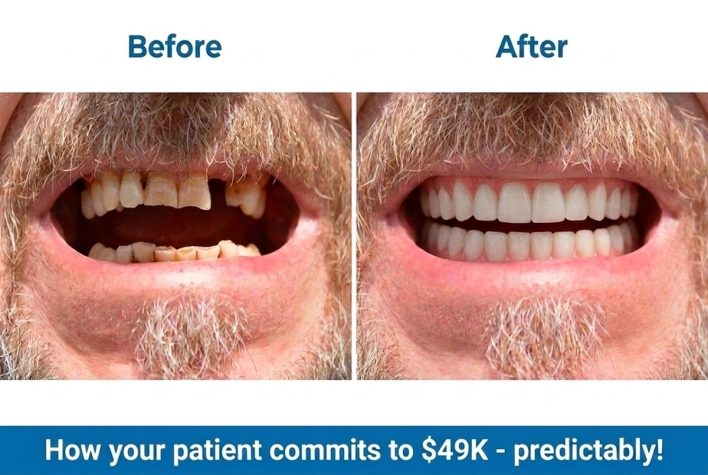
A significant share of dental patients who are in needed of major dental work are homeowners with ample equity in their homes. This equity could fund a large portion of their greatly needed dental care. Yet most treatment coordinators don’t understand how to approach this subject. This post explains how a treatment coordinator introduced the idea of using a Home Equity Line of Credit (HELOC) to partially fund his needed $49,000 dental implant procedure and what it looks like when a patient leaves the consultation with a plan.
Most large case dental consultations end the same way. The small amount covered by dental insurance is presented. One financing option is presented. If there is still a gap, the patient goes home to figure out for themselves.
Home equity is only considered when the patient thinks of it. Yet U.S. homeowners held nearly $35 trillion in home equity by the end of 2024, according to data from the Federal Reserve Bank of St. Louis. The average home equity level is close to $300,000.1
Sixty percent of homeowners are currently sitting on at least $100,000 in equity. This represents a significant portion of the patients in your practice that need life changing All-on-X implant procedures.
Meet Robert: A Patient With the Treatment Affordability Answer in His Home
How did one patient use a HELOC to make a $49,000 dual arch implant procedure affordable?
Robert is 61-year old electrical engineer who’s knocking on the door of retirement in four to five years. He presented with missing teeth in both arches, advanced periodontal disease, and multiple hopeless remaining teeth.
His dentist recommended full extractions and an upper and lower All-on-X implant procedure. The total fee presented was $49,000.
When Robert expressed concern for covering the cost of treatment, the treatment coordinator began the process of helping him to build a payment stack for the purposes of making his treatment affordable.
Figure Out an Affordable Solution for an All-on-X Candidate
Through the process of helping Robert arrive at an affordable solution, an experienced treatment coordinator understands the importance of gaining rapport and having a cordial money conversation.
After exhausting the possibilities of options like third-party patient financing, credit cards, HSA and the like, together they arrived at the following available resources:
- Dental insurance
- Cash payment
- FSA contributions for the coming year – 2026
- Home equity line of credit (HELOC)
At this point, the treatment coordinator has worked with Robert to establish a nice payment stack that should allow him to afford the treatment he needs and desires.
Dental payment stacking: the structured process of identifying and layering multiple patient funding sources such as insurance, cash, FSA, HSA, personal loans, and personal assets to make high-cost treatment plans affordable without discounting fees.
Robert’s stack is a precise illustration of that definition in practice.
| Funding Source | Amount |
| Dental Insurance | $900 |
| Cash Down Payment | $3,000 |
| FSA Balance | $3,400 |
| HELOC (7% / 84 months) | $41,700 |
| Est. Monthly HELOC Payment | $638.39 |
How Did Robert Leave the Office After Being Quoted a $49K Treatment Plan?
What does a patient take home after a HELOC-based payment planning consultation?
Even though Robert was not prepared to decide on a major expense, on the same day of his consultation, he wasn’t forced to leave the dental office with a vague sense of how to make his costly implant procedure affordable.
At the end of his consult, Robert was given a professionally generated payment plan that he and the treatment coordinator outlined together. Now Robert had a complete financial picture that he could discuss later with his wife.
On a simple 8.5 x 11 printout Robert’s insurance, cash deposit, FSA and HELOC estimate were listed in one place as a payment strategy.
The document not only demonstrated to Robert how he’d potentially cover his large fee, but it also produced an AI generated visual of how his smile could be improved by the recommended procedure.
Both attributes work in tandem to help close high cost treatment plans like Robert’s.
Robert and Wife’s $49,000 Treatment Discussion Simplified
Robert had a decision to make. Fortunately, before he left the dental office he already had a legitimate plan established.
In his mind, Robert had decided he wanted this implant procedure. Now he needed to convince his wife that it’s a worthwhile investment. To his surprise it didn’t require much convincing after he shared his plan.
The PDF printout Robert handed his wife included a ‘Before’ and (AI generated) ‘After’ image. She was instantly impressed by the visual of what his teeth could look like.
Naturally, Robert’s wife wasn’t expecting his treatment to cost nearly $50,000, but she also wanted what was best for his health.
When his wife saw that his procedure could be broken down into a monthly payment of roughly $630, she encouraged him to move forward. She was also in agreement with the use of a HELOC to make it possible.
Why a HELOC Can Work So Well For Large Dental Cases
What makes a HELOC a strong funding option for high-cost dental treatment?
The national average HELOC rate was 7.46% as of July 1, 2026, according to Bankrate’s national survey of lenders. That is down significantly from rates averaging close to 9% at the start of 2025.2
This rate is considerably lower than many of the patient financing products available for dental treatment.
The secured nature of a HELOC means patients with meaningful equity often qualify for larger draw amounts than they would through unsecured financing.
For patients 55 and older, a demographic that’s most often in need of All-on-X procedures, home equity represents access to affordable healthcare.
Drawing a modest portion of that equity to fund a life-changing procedure may be the catalyst that not only brings the patient joy, in many instances it may be the difference maker in extended life through the capability of healthier food choices.
After the 5% cash discount, Robert drew $41,700 against $350,000 in equity. His net equity position after the draw remained well above $300,000.
The Funding Source in the Room Nobody Mentions
Why do treatment coordinators rarely discuss home equity as a dental funding option?
While home owners routinely tap home equity to make needed healthcare procedure affordable, most treatment coordinators aren’t trained to bring up this resource as a potential solution.
The standard funding discovery conversation covers insurance, cash, credit cards and third-party patient financing options. That’s it. Home equity isn’t brought up because it feels like a financial infringement conversation the practice isn’t qualified to have.
That instinct is understandable. But a treatment coordinator’s role is not to advise a patient on whether or not to open a HELOC. The intent is merely to have the patient consider a HELOC when other options, like third-party patient financing, are not available.
Dental offices that understand how to ask the right questions, help the most patients achieve better health. They’re also the most productive practices.
The Funding Discovery Conversation: How to Bring Up Home Equity
How should a treatment coordinator ask a patient about home equity without overstepping the boundaries?
The question does not require financial expertise to ask. It does require proper timing and a genuine desire to help the patient. After insurance, cash, FSA, and HSA have been entered into the stack and the remaining financing gap is still significant, a natural transition exists.
Something like this: “Robert, do you happen to own your home? Some of our patients have found that a home equity line of credit gives them access to funding at rates that are often more competitive than traditional financing.”
This question is not financial advice. It’s merely having the patient consider this as one possibility. It’s up to the patient to consider it, or not.
The Case Closed Pro calculator makes this moment more effective because the patient has already been watching their treatment cost gap be reduced in real time.
When HELOC enters as a potential source, the patient is not hearing an abstract suggestion. They are watching a specific dollar amount apply to a gap they can see on screen.
HELOC as Part of the Payment Stack, Not a Replacement
How does HELOC fit into a dental payment stacking plan?
In the case of a costly All-on-X implant procedure, a HELOC can offer be a game changer.
The payment stacking sequence remains the same: insurance first, FSA and HSA, cash deposit, then HELOC covers the remainder.
The patient is not taking on new debt for bad reasons. Their health is involved, directly affecting longevity. This form of reframing matters in the consultation.
Robert and his wife felt the monthly HELOC payment of approximately $630 was a smart investment to make at this stage in his life.
In preparation for his retirement in the coming years, he appreciates knowing his teeth will not be a hinderance. This context changes how the patient processes the commitment.
What Case Closed Pro Makes Possible
How does the Case Closed Pro calculator support the HELOC conversation in a dental consultation?
Case Closed Pro includes a dedicated input for home equity and personal loan sources. The treatment coordinator enters the HELOC amount, selects an estimated interest rate, and chooses the repayment term. This generates an estimated monthly payment in real time.
The patient can see the number before they leave the practice rather than being sent home to figure it all out themselves.
At the end of every session, the calculator generates a professional payment plan document naming every chosen funding source, the financing terms, and the monthly commitment.
For a patient like Robert, that document showed a HELOC-funded strategy at $628 per month.
He could evaluate it, discuss it with his wife, and say yes with confidence.
FAQ
A Home Equity Line of Credit is a revolving line of credit secured against a homeowner’s equity. This is the difference between the home’s market value and the outstanding mortgage balance. There are no restrictions on using HELOC funds for dental treatment, making it a fully legitimate funding source for large comprehensive procedures. Unlike patient financing, which is unsecured and determined by credit profile alone, a HELOC is secured by the home, which typically allows for larger draw amounts and more competitive interest rates.
Patient financing approval amounts are determined by the lender and are not guaranteed to cover the full financing gap on a large case. A patient who needs $40,000 in financing may only be approved for $25,000, leaving a significant portion of the treatment unfunded. A HELOC is secured against the equity the patient already owns. The borrowing power is tied to the value of their home rather than their credit profile alone, which often makes larger draw amounts more accessible for patients with meaningful equity.
The treatment coordinator’s role is to ask one question that opens the door, not to advise the patient on whether to pursue a HELOC. A natural transition occurs after other funding sources have been entered and the financing gap is still significant. Asking whether the patient owns their home and has considered using available equity introduces the option without crossing into financial guidance. What the patient decides to do with that information is between them and their bank.
Case Closed Pro includes a dedicated input for HELOC and personal loan amounts. The treatment coordinator enters the draw amount, selects an interest rate, and chooses a repayment term to generate an estimated monthly payment in real time. That number appears alongside every other funding source applied in the session, giving the patient a complete, itemized payment strategy before the consultation ends. The generated payment plan document names HELOC explicitly as a funding source, making the patient’s financial picture clear and concrete.
Patients 55 and older who have owned their home for a decade or more represent the highest-probability demographic for meaningful equity. This group maps closely to the full arch implant and comprehensive reconstruction patient, making HELOC a particularly relevant funding conversation for the case types that generate the most production. According to Intercontinental Exchange data, 60% of homeowners currently have at least $100,000 in tappable equity, suggesting the opportunity is broader than most dental teams assume.
References
1. Federal Reserve Bank of St. Louis via CBS News. U.S. Homeowner Equity Data. 2024. cbsnews.com
2. Bankrate. Current HELOC Rates: National Survey of Lenders. July 1, 2026. bankrate.com
3. Intercontinental Exchange via Empower. ICE Mortgage Monitor: Tappable Equity Data. 2024. empower.com
Can I afford this?
More often than you think, the answer is yes.
Your team just needs the system to prove it.
Case-Closed Pro is a dental treatment financing calculator built for treatment coordinators who present large comprehensive cases. It combines up to twelve payment methods into a single patient-facing payment plan — built live, in the consult room, in minutes.