Why High-Cost Full Mouth Rehab Cases Stall and How to Fix It
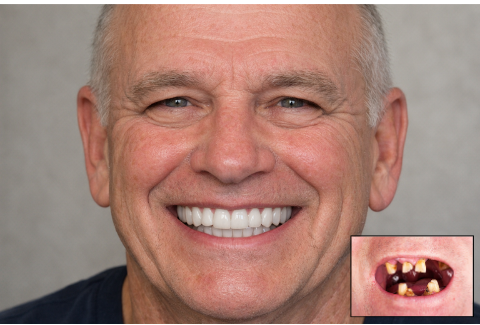
Full mouth rehab cases stall most often at the fee presentation, not the clinical recommendation. This post explains why the funding conversation is the real barrier, and how treatment coordinators who use a structured payment stacking approach close cases that single-source presentations consistently lose.
Full mouth rehab is the most comprehensive and consequential treatment a dental practice can recommend. It’s also the case type most likely to leave a treatment coordinator staring at an empty schedule line where a confirmed appointment should be.
The patient was engaged. The clinical need was clear. The treatment plan was thorough. And then they heard the fee and disappeared.
Understanding why these cases stall starts with recognizing that the problem almost never begins in the mouth. It begins in the fee presentation. This is what separates practices that routinely close full mouth rehab from those that don’t.
Full Mouth Rehab Is a Different Conversation
Why do patients walk away from full mouth rehab treatment plans?
A single implant, a crown, even a three-unit bridge are procedures patients can mentally compartmentalize. They hear the cost, they wince, and they find a way to manage it. Full mouth reconstruction doesn’t allow for that.
A treatment plan that spans periodontal therapy, extractions, two implants, bone grafting, and full arch restorations presents the patient with a number that often lands somewhere between $10,000 and $30,000 or more. That number doesn’t feel like a dental procedure. It feels like a second mortgage.
The psychological response is predictable. The patient shuts down, nods politely, takes the paperwork home, and never calls back. It isn’t because they don’t want the treatment. It’s because no one gave them a way to see themselves on the other side of the cost.
That’s the stall point. And it’s entirely fixable.
The Complexity Problem
Why is full mouth rehab harder to present than single-procedure cases?
Full mouth rehab cases carry an additional challenge that single-procedure cases don’t. They frequently unfold across multiple phases including initial therapy, surgical procedures, and restorative work, which means the patient is being asked to commit to a long-term financial relationship with the practice, not just a single payment decision.
When phasing is introduced without a clear funding framework, it compounds the confusion. The patient doesn’t know what they’re committing to today versus later, and uncertainty at that level almost always produces inaction.
The fix isn’t to simplify the clinical picture. It’s to simplify the financial one.
What the Presentation Is Missing
What is dental payment stacking and how does it apply to full mouth rehab?
Most treatment coordinators approach full mouth rehab cases the same way they approach every other case: insurance estimate, financing option, total cost. On a $5,000 C&B case, that framework may be adequate. On a $25,000 All-on-X case, it’s a significant liability.
The gap isn’t effort or intention. It’s the absence of a system that accounts for every available funding source and presents them as a unified, patient-specific plan. A patient who has dental insurance, a cash deposit they’re willing to make, an FSA balance, an HSA that has been accumulating for years, and the ability to finance the difference is a patient who can afford comprehensive dentistry. They simply need to be shown how to stack the resources they have.
Dental payment stacking is what transforms a $25,000 case into a monthly payment conversation. Dental payment stacking is the structured process of identifying and layering multiple patient funding sources such as insurance, cash, FSA, HSA, personal loans, and personal assets to make high-cost treatment plans affordable without discounting fees. Each funding source reduces the financing gap. The financing gap is what determines the monthly payment feasibility. Lower the gap, lower the payment, close the case.
Running the Numbers in the Room
How does a treatment coordinator build a payment plan during a full mouth rehab consultation?
The practices that close full mouth rehab cases consistently share one habit. They build the payment plan in front of the patient, not before the patient arrives.
When a treatment coordinator opens the Case Closed Pro calculator at the start of the consult and enters the treatment total, the conversation changes immediately. The patient isn’t being presented with a finished document and asked to react.
They’re watching their own funding sources being applied in real time: Insurance benefit entered. Cash deposit entered. FSA funds layered in. HSA funds accounted for. And the financing gap has shrunk with each step.
A $25,000 case with $1,000 in insurance, $3,000 in cash, $3,400 in FSA funds, and $5,000 in HSA leaves a $12,600 financing gap. At a seven-year term, that gap produces a monthly payment in the range of $190 to $220 depending on the interest rate the patient is approved for. These are numbers capable of breaking down any wall.
What to Do When the Case Has to be Phased
How do you present a phased full mouth rehab treatment plan to a patient?
When full mouth rehab cases require treatment phasing, the payment stacking conversation becomes even more valuable rather than more complicated. Breaking the total into phases doesn’t change the funding sources available. It changes the sequencing.
For example: A patient who understands that Phase 1 of treatment can be funded largely through their FSA and dental benefits feels confident treatment can begin. Phase 2 of treatment may be largely covered through treatment financing. As long as there’s a clear financial path to completion, starting is what matters. Practices that give patients a clear financial entry point into a phased treatment plan close far more comprehensive treatment plans than practices that present on one or two methods funding the procedure.
The Case Closed Pro calculator allows the TC to run the numbers on a phase-by-phase basis or on the total plan. This gives the practice flexibility in how they structure the conversation without losing the clarity of a unified payment framework.
The Document That Closes the Case
What should a patient take home after a full mouth rehab consultation?
High dollar, full mouth rehab cases rarely close in a single appointment. The patient needs time to process, discuss with a spouse, review their finances, and arrive at a decision. What determines if a patient comes back or not, in large part, has much to do with what you send them home with.
A verbal summary of funding options doesn’t hold up at the kitchen table. A professional, itemized payment plan document does. When the calculator session ends, Case Closed Pro generates a patient-facing payment plan that shows the total treatment cost, every funding source applied, the remaining financing amount, and the monthly payment timeline. The patient leaves with their plan in hand. This is very different from leaving with a generic brochure.
Patients who leave the consult with a personalized payment plan return at a significantly higher rate than patients who leave with a verbal summary and a printout of the fee schedule. The payment plan document does the closing work at the kitchen table when the treatment coordinator is no longer present.
The Practice-Level Impact
What is the production impact of closing more full mouth reconstruction cases?
One closed full mouth reconstruction case represents more production than many practices generate from dozens of routine appointments. Practices that develop a repeatable system for presenting and closing these cases don’t just improve their case acceptance rate. They restructure what their schedule looks like and what their production ceiling is.
The limiting factor for most practices isn’t their clinical capability or their patient volume. It’s the gap between the treatment they’re recommending and the payment infrastructure they’re offering.
Full mouth reconstruction is where that gap is most expensive. Closing the gap starts with giving your treatment coordinator a calculator that can handle the complexity of the case in front of them.
The patients are in the chairs. The treatment need is real. The funding sources are available.
The only thing that’s likely missing is the system to connect all three.
Frequently Asked Questions
Common questions about closing full mouth rehab cases
Why do full mouth rehab cases stall after the consultation? Most full mouth rehab cases stall because the patient leaves without a clear, personalized answer to the affordability question. A verbal summary of costs and a single financing option rarely survive the kitchen table conversation that follows. Patients who leave with a patient-specific payment plan showing every funding source applied return at a significantly higher rate than those who leave with generic paperwork.
What is dental payment stacking in the context of full mouth rehab? Dental payment stacking is the process of layering multiple patient funding sources — insurance, cash, FSA, HSA, and financing — to reduce the financing gap on a large treatment plan and arrive at a manageable monthly payment. On a full mouth rehab case, stacking is not optional. No single funding source is likely to close a $25,000 or $30,000 case on its own, and a single financing option often produces a monthly payment that ends the conversation before it begins.
How should a treatment coordinator handle a full mouth rehab case that requires phasing? Phasing doesn’t complicate the payment stacking conversation — it gives the treatment coordinator a clearer entry point. Phase 1 can often be funded through FSA and dental insurance benefits, giving the patient a financially accessible starting point. Practices that present a clear funding path for Phase 1 close far more phased treatment plans than practices that present the full scope and hope the patient can figure out the financing.
How does the Case Closed Pro calculator help close full mouth rehab cases? The Case Closed Pro calculator allows the treatment coordinator to build a personalized payment plan in real time, in the consult room, with the patient watching every funding source reduce the financing gap. It can run numbers on the full treatment total or on individual phases, and generates a professional patient-facing payment plan document the patient takes home. That document does the closing work at the kitchen table when the treatment coordinator is no longer present.
What monthly payment range should a treatment coordinator aim for on a full mouth rehab case? The target monthly payment depends on the patient’s situation, but the goal of payment stacking is to reduce the financing gap enough that the resulting monthly payment falls into a range the patient can reason about rather than react to. On a $25,000 case with $12,400 in stacked funding, the remaining $12,600 financed over seven years produces a monthly payment of roughly $190 to $220 — a number most patients can evaluate seriously rather than dismiss immediately.
Can I afford this?
More often than you think, the answer is yes.
Your team just needs the system to prove it.
Case-Closed Pro is a dental treatment financing calculator built for treatment coordinators who present large comprehensive cases. It combines up to twelve payment methods into a single patient-facing payment plan — built live, in the consult room, in minutes.